
How Glycolic Acid Supports Sensitive Skin When Used at the Right Concentration
Glycolic acid for sensitive skin is not a contradiction. It is a precision decision.
For years, sensitive skin received one piece of advice: avoid glycolic acid. However, this guidance mistakes concentration for mechanism. Mechanism is everything. At the right concentration, pH and formulation, glycolic acid does not disrupt sensitive skin. Instead, it works with the skin’s own renewal cycle — tending what the skin is already doing, rather than overriding it.
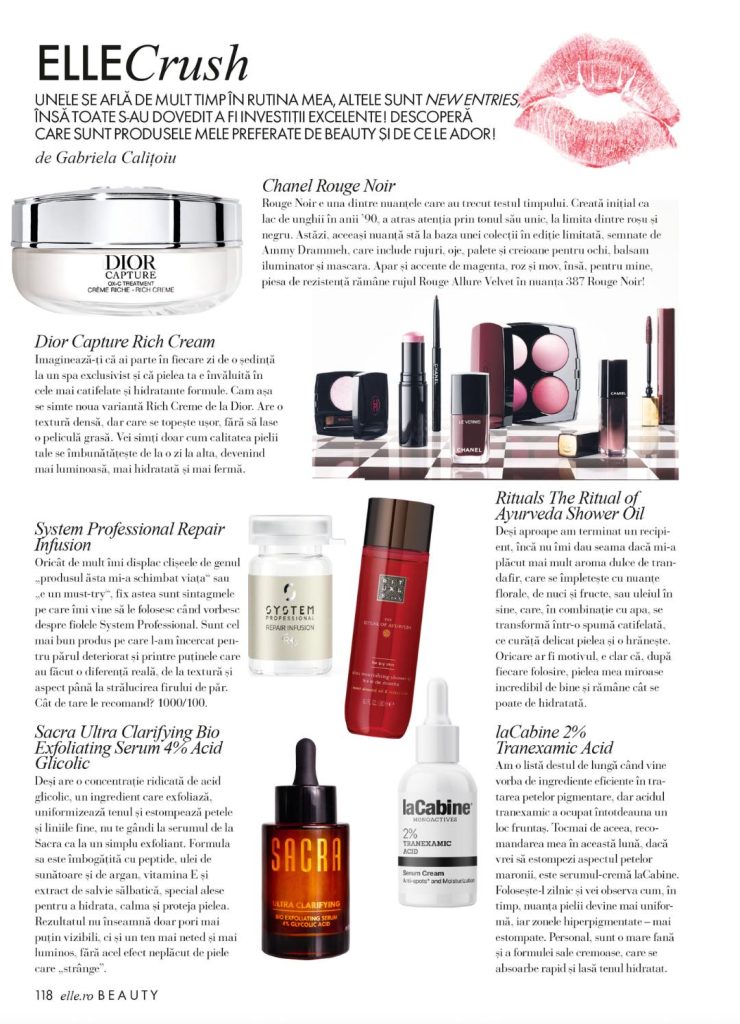
In 2026, SACRA’s Ultra Clarifying Bio Exfoliating Serum was recognized as an *ELLE Crush* by Gabriela Calitoiu, beauty editor at *Elle Romania*. She highlighted it alongside Dior, Chanel, and Rituals as part of her personal collection of products she currently uses, tests, and recommends. She described it as a formula that “exfoliates, evens out skin tone, and softens fine lines” while being “specially formulated to hydrate, soothe, and protect the skin” — noting that the results reveal “smoother, more radiant skin, without that unpleasant tight-skin sensation.”¹
So the real question for glycolic acid-sensitive skin isn’t whether to use it. It’s how. Understanding glycolic acid-sensitive skin begins with understanding what the concentration actually does to the mechanism.
Glycolic Acid for Sensitive Skin: Why Concentration Matters Most
Research on glycolic acid for sensitive skin consistently identifies 4% as the ideal threshold — effective enough to renew the skin, gentle enough to preserve the skin barrier.
Glycolic acid is a natural acid derived from sugar cane. It belongs to the alpha-hydroxy acid (AHA) family. Among all the AHAs, it has the smallest molecule. This means it penetrates the skin more quickly and deeply than lactic acid or mandelic acid. That is what makes it effective. However, it is also what gives it a reputation for causing irritation.
So size is the key variable. And concentration controls what that size does inside the skin.
What Happens at High Concentrations
At 10%, 15%, or 20%, the mechanism changes completely. Research in the *Journal of Cosmetic Dermatology* confirms this.² High concentrations don’t just exfoliate more. Instead, they break through the outer layer of the skin and begin to affect the living cells underneath. This disrupts the skin’s natural moisture barrier, increases water loss, and triggers inflammation. For sensitive skin already dealing with hormonal changes, redness, or a weakened barrier, this simply adds another problem on top of what they’re already experiencing.
What Happens at 4%
At 4%, the acid only affects the outermost layer — the stratum corneum. This layer consists of dead cells. It sits on top of the live skin underneath. The acid removes this surface layer without touching what lies beneath. As a result, controlled exfoliation takes place. The barrier remains intact. The skin doesn’t need to recover from the ingredient itself.
Moreover, the skin that ages well is not the one that’s been treated most aggressively. Whether glycolic acid-sensitive skin responds depends entirely on this distinction. It’s the skin whose intelligence others consistently respect.
The Glycolic Acid Benefits That Matter for Sensitive Skin
At 4%, glycolic acid loosens the bonds between dead skin cells. This supports the skin’s natural shedding process — rather than replacing it with something faster and harsher.
What Desmosomes Are and Why They Matter
Dead skin cells do not simply fall away on their own. They are held together by tiny protein bridges called desmosomes. As healthy skin cells mature, natural enzymes break down these bridges. This allows old cells to shed and new ones to rise to the surface. However, this process slows over time. Age, hormonal changes, UV damage, and chronic stress all reduce how well it works.
When shedding slows down, the skin looks dull and congested. The barrier weakens. Texture becomes uneven. This is not a problem to force away. It is a process that simply needs support.
Research in *Dermatologic Surgery* confirms that glycolic acid at low concentrations speeds up this natural shedding process without causing the disruption that stronger concentrations cause.³ The acid supports and accelerates a process that is already underway. It does not impose a faster, external one. In other words, it works with the skin’s own cycle — not against it.
The Glycolic Acid Benefits on the Surface
The benefits of glycolic acid for sensitive skin are the same as for any other skin type. First, it refines texture as the surface clears. Then, dark spots fade more quickly as newer skin cells come to the surface to replace pigmented ones. Additionally, radiance returns as the dull outer layer is lifted away. Furthermore, bio-exfoliation enhances how effectively the next products in your routine are absorbed. Peptides and botanical oils penetrate deeper and work more effectively because the skin’s surface is prepared to receive them.
In short, none of this requires force. It requires consistency and the patience to gently support the skin’s natural cycle.
Glycolic Acid Sensitive Skin Science: The Coherence Axis: What the Body Has to Do With It
Sensitive skin is rarely just a surface issue. Understanding glycolic acid for sensitive skin means understanding what is happening beneath the surface — in the body’s broader regulatory systems.
Most people think of exfoliation as simply removing dead cells. Clearer, fresher skin appears. And that’s true. But it’s only part of the picture.
The skin is a living organ. It constantly communicates with the brain, the hormonal system, the immune system, and the gut. What appears on the surface often reflects what is happening throughout the entire body.
The Three Axes That Affect Sensitive Skin
Chronic stress increases cortisol. Cortisol then weakens the skin barrier. It also accelerates collagen breakdown.⁴ This is the brain–skin axis at work.
Estrogen decline — particularly during perimenopause — decreases the enzymes responsible for natural skin shedding. As a result, the renewal cycle slows precisely when the skin becomes most reactive.⁵ This is known as the hormone–skin axis.
Similarly, poor gut health triggers immune activation. This leads to barrier inflammation and increased skin sensitivity.⁶ This is the immune–skin axis.
Why This Changes the Glycolic Acid Question
Therefore, applying glycolic acid to sensitive skin does not work on its own. At high concentrations, it adds stress to a system already under pressure. However, at 4%, when integrated into a carefully formulated bio-exfoliation product, it actively assists the skin in restoring balance. It gently restarts the renewal cycle that systemic stress has slowed — without increasing the inflammatory burden that stronger concentrations would cause.
Above all, the most sensitive skin is often the skin most in need of supported renewal. The question is simply whether the approach helps the system — or strains it further.
The Benefits of Glycolic Acid Beyond Exfoliation: How Bio-Exfoliation Enhances Hydration
4% glycolic acid not only removes dead cells. It also signals the dermis to produce more of its own hyaluronic acid — enhancing the skin’s ability to retain moisture from within.
This is one of the most overlooked benefits of glycolic acid. And for sensitive skin, it may be the most important one.
Why Moisture Loss Is Not Just About Dryness
The skin doesn’t just lose moisture over time. It loses its ability to retain moisture. These are two different issues and require different solutions.
Scientific insights into glycolic acid and sensitive skin highlight a benefit often overlooked in many routines. The dermis — the deeper layer of skin — contains a network called the extracellular matrix. This network is composed of molecules known as glycosaminoglycans (GAGs). GAGs attract water and maintain the structure surrounding collagen fibers, keeping it stable. However, their production declines with age, sun exposure, and chronic inflammation.
Research in Dermatologic Surgery shows that low-dose glycolic acid stimulates the cells that produce GAGs.³ As a result, the skin becomes better at retaining water from within. It does not simply rely on moisturizer applied on the surface.
What This Means for Sensitive Skin
This is especially important for sensitive skin. Reactive skin often appears dehydrated and inflamed at the same time. The skin’s barrier is compromised. Water escapes easily. Yet, the skin also overreacts to many hydrating products. Controlled bio-exfoliation at 4% addresses both problems together. It enhances the barrier’s strength and intrinsic hydration simultaneously. Moreover, it does so without the inflammatory side effects associated with stronger formulations.
This is not what most people expect glycolic acid to do. Yet it is what glycolic acid, used correctly, actually does.
Why pH Determines Whether Glycolic Acid for Sensitive Skin Works or Disrupts
Glycolic acid only works within a specific pH range. Without the right pH, even a well-formulated 4% product delivers nothing — regardless of what the label says.
Concentration alone tells half the story. pH tells the other half.
How pH Controls Acid Activity
Below pH 3.5, free acid activity becomes clinically aggressive. This is true regardless of how low the stated percentage is. Above pH 4.5, the acid neutralizes and becomes largely inactive. Therefore, a product marketed as 4% glycolic acid but formulated at pH 5.0 delivers almost no exfoliation. Research from Clinical, Cosmetic and Investigational Dermatology confirms that concentration and pH must always be read together.⁷ Neither is meaningful without the other.
The Problem With “Gentle” Glycolic Products
For glycolic acid-sensitive skin, this has a direct impact. Many products achieve their gentleness not through careful formulation but through neutralization. The acid becomes inactive. The skin experiences no disruption because it experiences no exfoliation. As a result, the benefits of glycolic acid never actually occur.
5 For this reason, SACRA’s Ultra Clarifying Bio Exfoliating Serum maintains a pH of 3.6–3.9. Achieving and sustaining this required extensive stability and safety testing. It is not a minor detail. It is the decision that enables every other benefit.
SACRA’s Bio-Exfoliation System: Glycolic Acid Designed for Sensitive Skin, Fully Supported
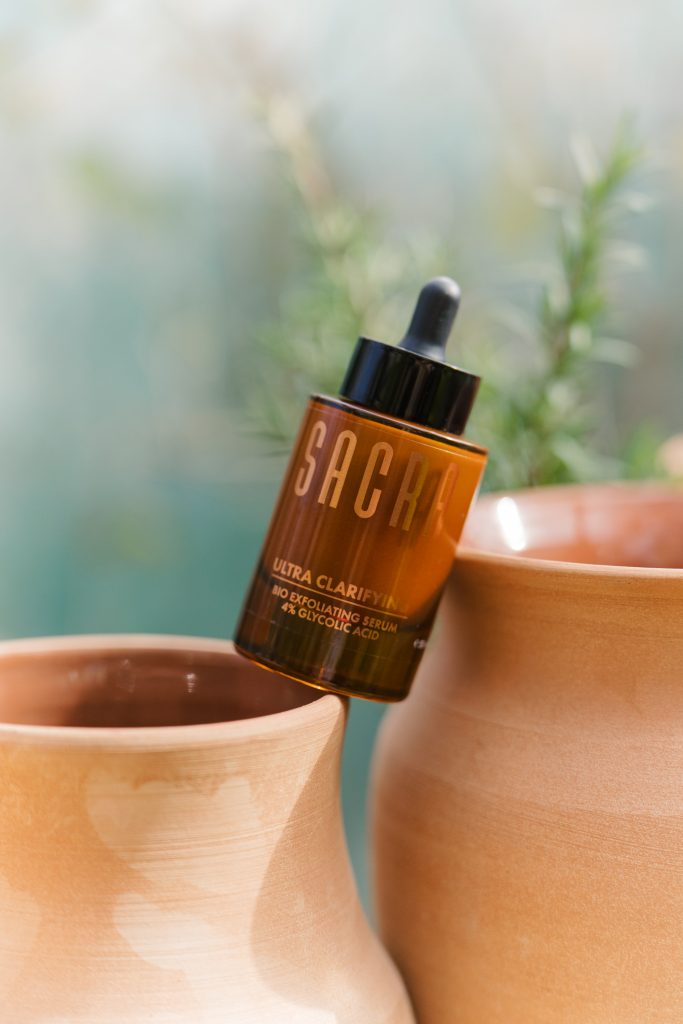
SACRA combines 4% glycolic acid with a five-peptide complex, prickly pear seed oil, argan oil, glycerin, and clary sage extract. Exfoliation and barrier support happen simultaneously — not one after the other.
The skin shouldn’t have to choose between renewal and stability. This formula makes that choice unnecessary.
The Peptide Complex
Myristoyl Tetrapeptide-34 directly calms the skin’s inflammatory response. This helps reduce the redness that glycolic acid can cause in sensitive skin. Myristoyl Tripeptide-31 supports gentle cell renewal without irritation that some peptides may cause. Palmitoyl Pentapeptide-4 enhances collagen production in the deeper skin layers exposed by bio-exfoliation. Myristoyl Tetrapeptide-6 helps maintain firmness and resilience throughout the renewal process.
The Botanical Oils and Humectants
Prickly pear seed oil is rich in linoleic acid and vitamin E. It protects the barrier and counteracts the oxidative stress that exfoliation can create in compromised skin. Argan oil provides antioxidant support and replenishes surface lipids. Glycerin retains hydration in freshly exfoliated skin. Clary sage extract moderates reactivity throughout the renewal phase.
As Elle Romania’s Gabriela Calitoiu mentioned, the formula is “enriched with peptides, cactus and argan oils, vitamin E, and clary sage extract.”¹ However, it is the complete system — not any single ingredient — that enables glycolic acid for sensitive skin to renew without disruption.
How to Use Glycolic Acid for Sensitive Skin: Consistency Over Intensity
Start slowly, build gradually, and let consistency do the work. The skin does not need pushing into renewal. It needs tending toward it.
Start with two evenings a week. Apply the serum after cleansing onto dry skin. Then wait two minutes before applying your oil or night cream. This pause allows the acid to finish its work before the barrier-sealing phase begins.
Always apply broad-spectrum SPF the following morning. Freshly exfoliated skin has reduced natural sun protection. UV exposure at this stage causes new oxidative damage — and that directly undoes the renewal work.⁸
Once the foundation is established, increase to every other evening after three to four weeks — if the skin responds without redness or flare-ups. However, the goal here is not frequency. The goal is steady, uninterrupted improvement. Skin that progresses consistently — without interruptions, without recovery periods — maintains results much longer than skin pushed too hard too soon.
This is the principle of glycolic acid for sensitive skin that changes outcomes — not the strength of the formula, but the steadiness of the hand that tends it. Consistency is the only meaningful rhythm here. Not intensity.
Frequently Asked Questions
Is glycolic acid safe for sensitive skin? Yes — and the reason is straightforward. At 4%, within pH 3.6–3.9, glycolic acid works only on the outermost skin layer. It does not touch the living cells beneath. SACRA also pairs it with a four-peptide complex and barrier-supporting oils. As a result, bio-exfoliation and barrier protection happen simultaneously — not at the expense of each other.
What are the main benefits of glycolic acid for sensitive skin? Simply put, glycolic acid gently refines the surface while supporting what lies beneath. At 4%, the primary benefits include improving skin texture, boosting radiance, and fading dark spots through steady cell turnover. Additionally, bio-exfoliation enhances how well subsequent products are absorbed. Peptides and botanical oils penetrate deeper and work more effectively because the skin surface is clear and prepared.
**What is the best glycolic acid percentage for sensitive skin?** In short, 4% is the concentration that research consistently identifies as effective for glycolic acid sensitive skin without compromising the barrier. However, concentration and pH must always be considered together. A higher-percentage product with a higher pH may provide less exfoliation — and fewer benefits from glycolic acid — than a properly formulated 4% serum.
How does controlled exfoliation differ from standard AHA exfoliation? The difference is fundamental. Controlled exfoliation operates within the skin’s own renewal capacity rather than overriding it. Standard AHA formulations at higher concentrations accelerate turnover, leading to more immediate visible results but also placing additional stress on barrier repair systems. For glycolic acid-sensitive skin, controlled bio-exfoliation yields better long-term results because the skin never has to recover from the exfoliation process itself.
Can glycolic acid be used on hormonally reactive skin? Yes — and in fact, it is often particularly well suited for it. The decline of estrogen during perimenopause reduces the enzymes responsible for natural skin shedding. As a result, the skin’s renewal cycle slows precisely when the skin is most reactive. 4% glycolic acid gently restarts this slowed cycle. Additionally, SACRA’s peptide complex specifically regulates the inflammatory response during exfoliation — making the formula suitable for skin in hormonal transition.
How long does glycolic acid take to show results on sensitive skin? Glycolic acid works in its own time. Texture and clarity typically improve within two to three weeks of consistent use. Hyperpigmentation and pore refinement develop over six to eight weeks. Unlike high-concentration treatments, there is no disruption phase to go through first. Therefore, sensitive skin improves steadily from the first applications — without a reactive period before progress begins.
Does glycolic acid thin the skin over time? This is a common misunderstanding of how it works. Short-term exfoliation slightly reduces the outermost layer — and that’s exactly how it improves texture and restores radiance. However, consistent long-term use at low concentrations actually thickens the dermis by stimulating collagen production and GAG synthesis.³ With sustained, controlled use, the skin becomes structurally stronger. Not thinner. Not more fragile. More coherent.
Has SACRA’s serum received independent editorial recognition? Yes. SACRA’s Ultra Clarifying Bio Exfoliating Serum received the ELLE Crush designation from Gabriela Calitoiu, beauty editor at Elle Romania, in 2026. She featured it alongside Dior, Chanel, and Rituals as part of her personal selection of products she currently uses, tests, and recommends.¹ The recognition reflects the serum’s status as a high-performance formula that offers the full range of glycolic acid benefits — without the barrier disruption associated with traditional AHA treatments.
Sources & Further Reading
- Calitoiu G. “ELLE Crush.” Elle Romania, March 2026.
- Draelos ZD. “Alpha hydroxyacids modulate stratum corneum barrier function.” Journal of Cosmetic Dermatology (Ref. via PubMed).
- Bernstein EF, et al. “Glycolic acid treatment increases type I collagen mRNA and hyaluronic acid content of human skin.” Dermatologic Surgery, 2001.
- Arck PC, et al. “Neuroimmunology of stress: skin takes centre stage.” Journal of Investigative Dermatology, 2006.
- Stevenson S, Thornton J. “Effect of estrogens on skin aging and the potential role of SERMs.” Clinical Interventions in Aging, 2007.
- Salem I, et al. “The gut microbiome as a major regulator of the gut-skin axis.” Frontiers in Microbiology, 2018.
- Kornhauser A, et al. “Applications of hydroxy acids: classification, mechanisms and photoactivity.” Clinical, Cosmetic and Investigational Dermatology, 2010.
- Kaidbey K, et al. “Topical glycolic acid enhances photodamage by ultraviolet light.” Photodermatology, Photoimmunology & Photomedicine, 2003.


